
A contract coffee packer in Poland runs six SKUs a day: three roast levels, two pack sizes, one decaf. His line looks fast on paper — 60 bags a minute — but he only gets about four productive hours out of an eight-hour shift.
The rest goes to changeover. Forty minutes each time, six times a day.
When he asked us for a faster machine, we asked for his changeover log first. The log showed something he had not noticed: eleven of the forty minutes were spent looking for the right forming tube and the right set of jaws.
Where changeover time actually goes
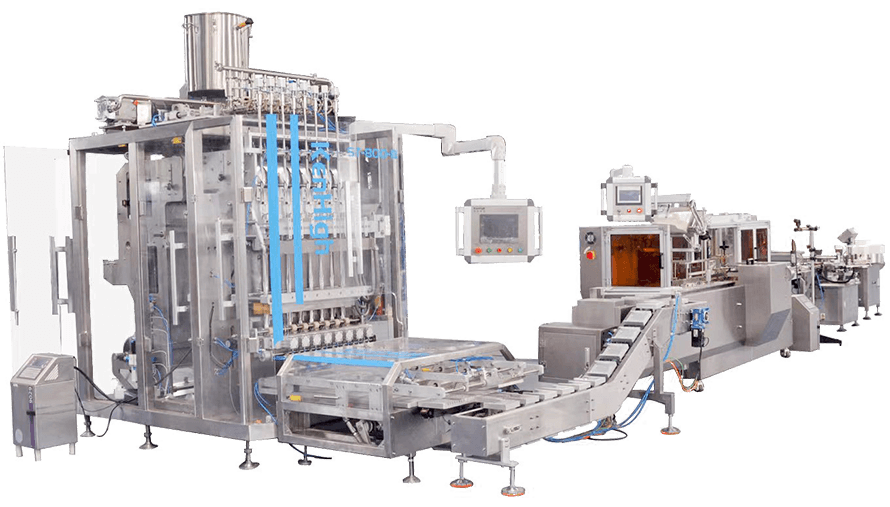
A changeover is not one task. On a modern VFFS line it breaks down roughly like this:
- Strip and clean: 8–15 minutes, depending on how much product is stuck to the former and the seal jaws.
- Change format parts: 5–20 minutes — forming tube, jaw set, bag length, sometimes the whole film path.
- Parameter recall: 2 minutes on a machine with recipe memory, 10–15 minutes on one where an operator re-enters temperature, dwell, and film speed by hand.
- Trial seals and first-article check: 5–10 minutes. This is not waste; skipping it is how you ship leaking bags for the first hour.
- Searching, walking, waiting: the number nobody logs, and usually the biggest one.
That last line is where most factories lose the money. A changeover that requires a tool, a manual, and a supervisor’s approval is a 40-minute event. The same changeover with colour-coded parts, a parts cart next to the machine, and one-touch recipe recall is a 12-minute event.
Three machine types, three changeover realities
VFFS granule lines with a volumetric cup or auger are the slowest to change over. Every new bag width needs a different forming tube, every new fill weight needs a different cup or screw. On a well-designed machine with quick-release clamps this is 15–20 minutes; on an older one with bolts, it is 45.
Pre-made pouch machines are the fastest format change we sell. The bag is already made, so there is no forming tube and no seal geometry change — you adjust the gripper width, load a new pouch stack, and recall the recipe. Ten to fifteen minutes, and no film waste.
Multilane stick machines change over per lane, not per machine, which is either an advantage or a trap. If all lanes run the same SKU, changeover is a single setup. If you need mixed lanes, the setup multiplies.
The equipment pages carry the specifics for each: [VFFS machines](https://jingrui-packingmachine.com/product-category/vffs-packing-machines/), [pre-made pouch lines](https://jingrui-packingmachine.com/product-category/pre-made-pouch-packing-machines/), and [multilane stick packers](https://jingrui-packingmachine.com/product-category/multilane-stick-packing-machines/).
The honest answer on small batches
If you run more than eight SKUs a day with batches under 500 bags, a fully automatic line is usually the wrong purchase. Not because it cannot do the work, but because you will spend 40% of the shift changing it over instead of running it.
For that profile, a semi-automatic [pre-made pouch machine](https://jingrui-packingmachine.com/product/premade-pouch-granular-packing-machine-coffee-beans-packing-machine/) with a weigh-fill station is the better spend. Slower per bag, far faster per changeover, and it does not need a technician to swap formats.
The opposite is also true. If you run one SKU, twenty hours a day, five days a week, do not pay for quick-change hardware you will use twice a year. Put the money into the sealing and weighing side instead.
Three numbers to ask for before you sign
Changeover minutes, stated in writing, for a specific format change. “Fast changeover” is not a specification. Ask for the number of minutes to go from a 250 g pillow bag to a 500 g pillow bag, with the same operator, on video.
Number of parts that need a tool. Every bolted part is two minutes. Count them on the drawing, not in the brochure.
Recipe memory slots and who can edit them. A machine with 20 stored recipes and operator-level recall is a different factory from one where the supervisor re-enters temperatures each morning.
If you want to see where changeover sits in the wider purchase decision, our [timeline of buying a packing machine](https://jingrui-packingmachine.com/packing-machine-buying-timeline/) covers what happens from first email to loading day, and the [first packing line cost breakdown](https://jingrui-packingmachine.com/first-packing-line-cost/) shows how much of the budget goes to changeover capability versus speed.
One more consideration that often decides the format question: what the bag itself does on the shelf. The [pillow versus stand-up versus brick bag comparison](https://jingrui-packingmachine.com/pillow-bag-vs-stand-up-pouch-vs-brick-bag/) covers which formats actually sell, and why a quicker changeover is worth nothing if the format is wrong.
Send us your SKU list, batch sizes, and current changeover log. We will tell you which machine type actually fits that pattern — including when the answer is to buy a smaller machine than the one you asked about.
FAQ
How long should a changeover take on a VFFS machine?
For a bag width and fill weight change on a machine with quick-release parts and recipe memory, 12 to 20 minutes is realistic. The same change on a bolted machine without recipe recall is 40 to 60 minutes. Ask the supplier for the number in writing for a specific format change, not a general claim.
Is a pre-made pouch machine better for many small batches?
Usually yes. There is no forming tube to swap and no seal geometry to adjust, so a format change is 10 to 15 minutes and there is no film waste during setup. The trade-off is a higher cost per bag, which matters when volume is high.
When is a fully automatic line the wrong choice?
When you run more than eight SKUs a day with batches under 500 bags. At that pattern the line spends close to half the shift being changed over. A semi-automatic machine with a weigh-fill station produces less per hour but far more per shift.