
A detergent packer in Kenya asked us to quote a second line. He had bought the first one from us three years earlier and knew exactly what it produced. What he did not know was what it cost to run.
When we pulled the numbers with him, the electricity bill was twice what he had assumed. The main motor was 5.5 kW. The air compressor feeding the machine was 7.5 kW, and it ran whenever the line ran. He had budgeted for one machine’s power and was paying for two.
That is the pattern with running costs: the machine you quote is never the only thing drawing power.
What a packing line actually consumes
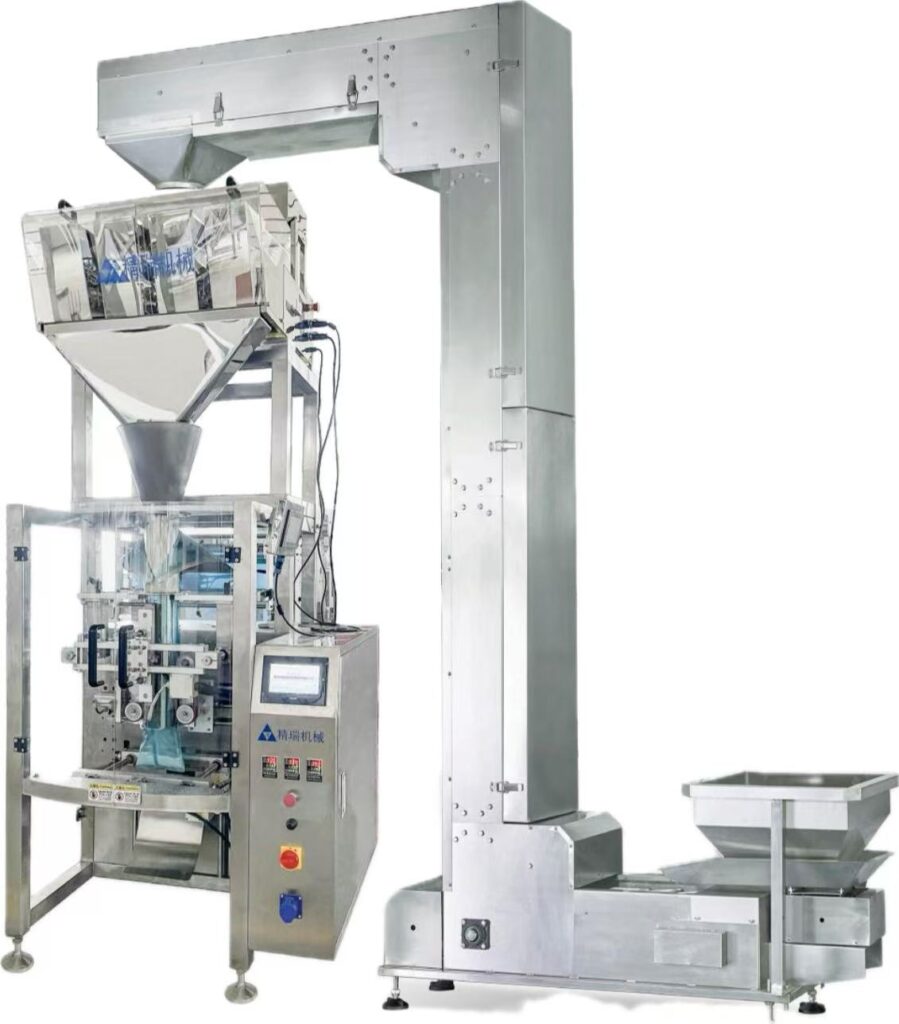
Electricity, and the part that is invisible. A VFFS line of the size that does 40–60 bags a minute draws 5.5–7.5 kW at the machine. Add the compressor at 7.5–11 kW, the chiller for the seal jaws at 1–2 kW if you have one, and the conveyor at 0.5 kW. Call it 15–20 kW for the whole cell.
At 16 hours a day, 300 days a year, and $0.12 per kWh, that is roughly $8,600–11,500 a year — before you count the plant’s general load. In countries with $0.25 electricity it doubles.
Film waste, which hides in the setup. Every startup, every changeover, every parameter change produces bags that go in the bin. On a well-run line this is 2–3% of film; on a line without recipe memory and with untrained operators, we have measured 7%.
Film at $3.20/kg, a 500 g bag using 6 g of laminate, 6 million bags a year: 36 tonnes of film. A 5-point swing in waste rate is 1.8 tonnes a year, about $5,800. That is not a rounding error, and it never appears in a quote.
Compressed air leaks. Air is the most expensive utility in a packing hall per unit of energy, and the most commonly ignored. A single 1 mm leak in a fitting costs about $300 a year at 6 bar. Walks through older plants usually find six to ten of them.
Spare parts on a real schedule. Seal bars and PTFE tape every 3–6 months depending on film and temperature. Cutting blades every 6–12 months. Vacuum pump vanes and filters yearly on vacuum lines. Belts and grippers on pouch machines. Budget 2–4% of the machine price per year, and more in the first year if the machine arrived with soft parts that were never specified.
Operator attention. Not a wage argument — a staffing ratio. A line that needs a constant operator plus a technician on call costs differently from one that runs a shift unattended. Ask how many interventions per hour the machine needs, not how many operators the brochure claims.
The number most buyers never compute
Cost per thousand bags. It is the only figure that lets you compare two machines honestly.
Take the total annual running cost — power, film waste, spares, maintenance labour — and divide by annual output in thousands. A cheap machine that wastes 6% film and needs a technician twice a month often lands higher than a machine that costs 20% more at purchase.
We have seen the ranking flip on exactly this calculation. The machine that was $9,000 cheaper had a 4-point higher film waste rate and a seal bar that needed changing every ten weeks instead of every six months.
When running cost should change your decision
If your utilisation is below 40%, do not buy a bigger machine to lower cost per bag. At low utilisation the fixed costs — power, maintenance, floor space — dominate, and a smaller machine running near capacity beats a large one idling. We covered the purchase side in [what a first packing line really costs](https://jingrui-packingmachine.com/first-packing-line-cost/); this is the other half of the same spreadsheet.
If your product is low-value and high-volume, film waste is your biggest lever. Spend on recipe memory, servo film feed, and operator training rather than on speed.
If you are running many small batches, the changeover waste will dominate everything else, and the answer is a machine that changes format quickly rather than one that runs fast — the arithmetic is in [the real cost of small batches](https://jingrui-packingmachine.com/packing-machine-changeover-time/).
Three questions before you sign
Ask for the connected load in kW, including the compressor and chiller the machine requires — not just the machine’s own motor rating. Ask what film waste rate the supplier considers normal during setup, and get a number rather than “minimal”. Ask for the recommended spare parts list with prices and replacement intervals, and multiply it out for three years.
A supplier who can answer those three in writing is a supplier who has watched machines run in the field, not only in a showroom.
Send us your product, bag size, shift pattern, and local electricity price, and we will build the running-cost estimate alongside the machine quote, so the comparison is between two totals and not two prices.


